What Does Chimney Stack Maintenance Actually Cover?
Stack maintenance is the work on the part of the chimney standing outside the house: the crown on top, the cap over the flue, the mortar joints in the brickwork, and the flashing where the stack meets the roof. All four exist to keep water out, and in St. Louis water is what destroys chimneys — not fire, and not age on its own. A stack in ordinary condition needs looking at every couple of years; one that has already lost mortar needs it sooner.
Updated September 15, 2026
What people mean by the stack
The stack is the masonry you can see — the column of brick standing above the roof, and the part of it running through the roof structure. It is not the flue, which is the passage inside it, and it is not the firebox down in the room.
The distinction matters because the stack and the flue fail for different reasons and get fixed by different work. A flue fails from heat, creosote and cracked liner tiles. A stack fails almost entirely from water: rain landing on top of it, and rain running down the face of it and finding its way in through joints that have opened up.
That is why stack maintenance is a short and fairly predictable list. There are four parts doing the waterproofing, and when a stack is deteriorating it is nearly always because one of them has stopped doing its job.
The four parts, and what each one is for
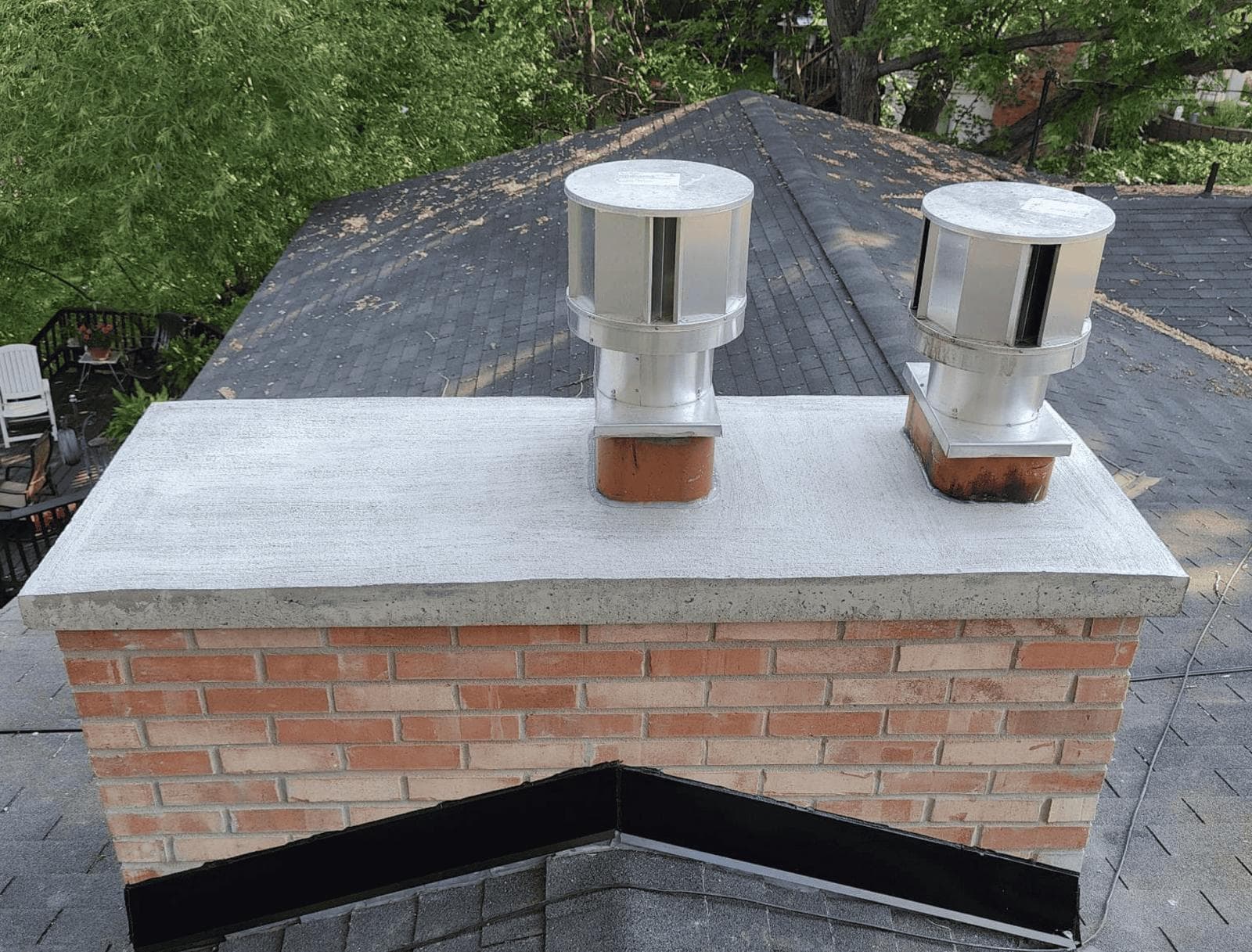
The crown is the sloped concrete or mortar slab across the top of the stack. Its job is to shed water away from the brick, which means it needs a slope and an overhang with a drip edge so the runoff clears the masonry instead of running back down it. A great many older St. Louis chimneys were built with a flat mortar wash instead of a proper crown, and a flat top holds water rather than shedding it. The crown is where stack problems usually start.
The cap sits over the flue opening. It keeps rain, birds and squirrels out of the flue itself. An uncapped flue takes every drop of rain that falls on it straight down into the chimney, where it soaks the liner and the smoke chamber from the inside.
The mortar joints hold the brick together and keep water out of the wall. Repointing — cutting out failed mortar and replacing it — is the maintenance that keeps a stack standing. On pre-1940 St. Louis homes the original mortar is soft lime, which is deliberately softer than the brick and wears faster by design.
The flashing is the metal seal where the stack passes through the roof. It is the single most common source of a chimney leak, and the one most often patched with caulk rather than repaired. Caulk on flashing is a two-year fix at best.
Why St. Louis is hard on stacks specifically
Our winters cross freezing and thawing repeatedly rather than staying cold. Every cycle, water that has soaked into brick or mortar expands as it freezes, and the material loses a little structure. That is the mechanism behind spalling — brick faces popping off — and it is why a stack here ages faster than the same stack would in a steadier climate.
The older housing stock makes it worse in a specific way. Much of St. Louis City is pre-1930 brick built with soft lime mortar, and it is common for a single stack to carry two, three or four separate flues — one per fireplace plus the furnace. More flues means a wider stack, a larger crown, and more joints exposed to weather.
It also means more places for an old problem to hide. On many City homes one flue was relined at some point and the others were not, and flues abandoned decades ago were often never sealed. From the ground, all of that looks like one chimney.
How often a stack actually needs attention
A stack in sound condition, with a proper crown and intact flashing, wants looking at every two years or so. That is an inspection, not work — most of those visits end with nothing needing doing.
A stack that has already started losing mortar is on a different clock. Once water is getting into the wall, each winter takes more out of it than the last, and repointing a section is far cheaper than rebuilding it after the brick itself has gone soft.
The useful signals are visible from the ground with a pair of binoculars: brick faces flaking or popping off, gaps you can see daylight through, a crown that is cracked or has no overhang, a missing or rusted cap, dark staining on the brick below the roofline, and mortar you can rake out with a screwdriver.
What it costs to leave it
Water that gets past the stack does not stop at the stack. It reaches the roof structure, the ceiling below, and the flue lining, and a saturated chimney in a freezing week does damage that no amount of later repointing reverses.
The ordinary progression is: crown cracks, water enters, mortar joints fail, brick faces spall, and eventually the section above the roofline has to be rebuilt rather than repaired. Each of those steps is meaningfully more expensive than the one before it, and the first one is usually a few hours of work.
That is the whole case for maintenance on a chimney. It is not that neglect produces a sudden failure. It is that every stage of the decline costs more than the stage before, and the cheapest point to intervene is always the one that looks least urgent.
What we look at, and what it costs
Our inspection is a flat 69 dollars anywhere in the St. Louis metro, with no trip charge. On the stack we check the crown for cracks, slope and overhang, the cap and its fixings, the mortar joints across all faces, the flashing seal, and the brick for spalling and water staining. You get a written report with photographs of the top of the stack, which is the part you cannot see from the ground.
If work is needed you get one fixed price in writing before anything starts, and the 69 dollars comes off it in full. If nothing is needed, the report saying so is what you paid for — and it is worth having in writing before a winter rather than after one.
What this looks like on a real job
Photographs from our own work in the St. Louis metro.
Common questions
What is the difference between the chimney stack and the flue?
The stack is the masonry structure you can see; the flue is the passage running up inside it. They fail differently — the stack from water getting in through the crown, joints or flashing, and the flue from heat, creosote and cracked liner tiles — so they are inspected and repaired as separate things.
How often does a chimney stack need maintenance?
A stack in sound condition wants inspecting roughly every two years, and most of those visits find nothing that needs doing. Once mortar has started to fail the interval shortens, because each freeze-thaw winter takes more out of an already-open joint than out of a sealed one.
Can I tell from the ground whether my stack needs work?
Some of it. With binoculars you can usually see brick faces flaking, a cracked crown or one with no overhang, a missing or rusted cap, and dark water staining below the roofline. What you cannot see from the ground is the top surface of the crown and the state of the flashing seal, and those are the two that matter most.
Is repointing the same as a rebuild?
No, and the difference is large. Repointing cuts out failed mortar and replaces it while the brick stays where it is. A rebuild takes the stack down to sound masonry and builds it back up. Repointing in time is what prevents a rebuild later — once the brick itself has gone soft, repointing no longer holds.
My chimney is not used. Does the stack still need maintenance?
Yes, and it is the part that does. An unused fireplace means no creosote and no flue heat, but the stack is still standing outside in the same rain and the same freeze-thaw winters as everyone else's. Water damage does not care whether anyone lights a fire.
Does waterproofing a chimney actually help?
A breathable masonry sealer can help a sound stack shed water, but it is not a repair. Applied over failed mortar or a cracked crown it seals moisture in rather than out, which makes things worse. It belongs at the end of the work, not instead of it.
If this sounds like your chimney
A $69 inspection tells you exactly which of these it is, with photos, before anyone quotes a repair.
Chimney Masonry & Tuckpointing
Tuckpointing is the process of grinding out failed mortar joints and packing in fresh mortar. Done properly, with mortar matched to the original, it buys a St. Louis chimney decades before the masonry needs attention again.
Chimney Inspection
A full chimney inspection with Total Chimney Services costs $69 anywhere in the St. Louis metro, and the entire $69 is credited back to you if you book a repair with us.
Chimney Cap Installation
A chimney cap is a metal cover with mesh sides that sits on top of the flue. It keeps out rain, animals and debris, and stops burning embers from landing on your roof. It is the cheapest part of a chimney and it prevents the most expensive problems.
Not sure which one this is?
Start with a $69 inspection and a photo report. Credited back in full when you book the work. Call (314) 887-7250.
Open 24/7 · Emergency service, day or night.